Work we do
We tailor the work to the actual condition of the facade.
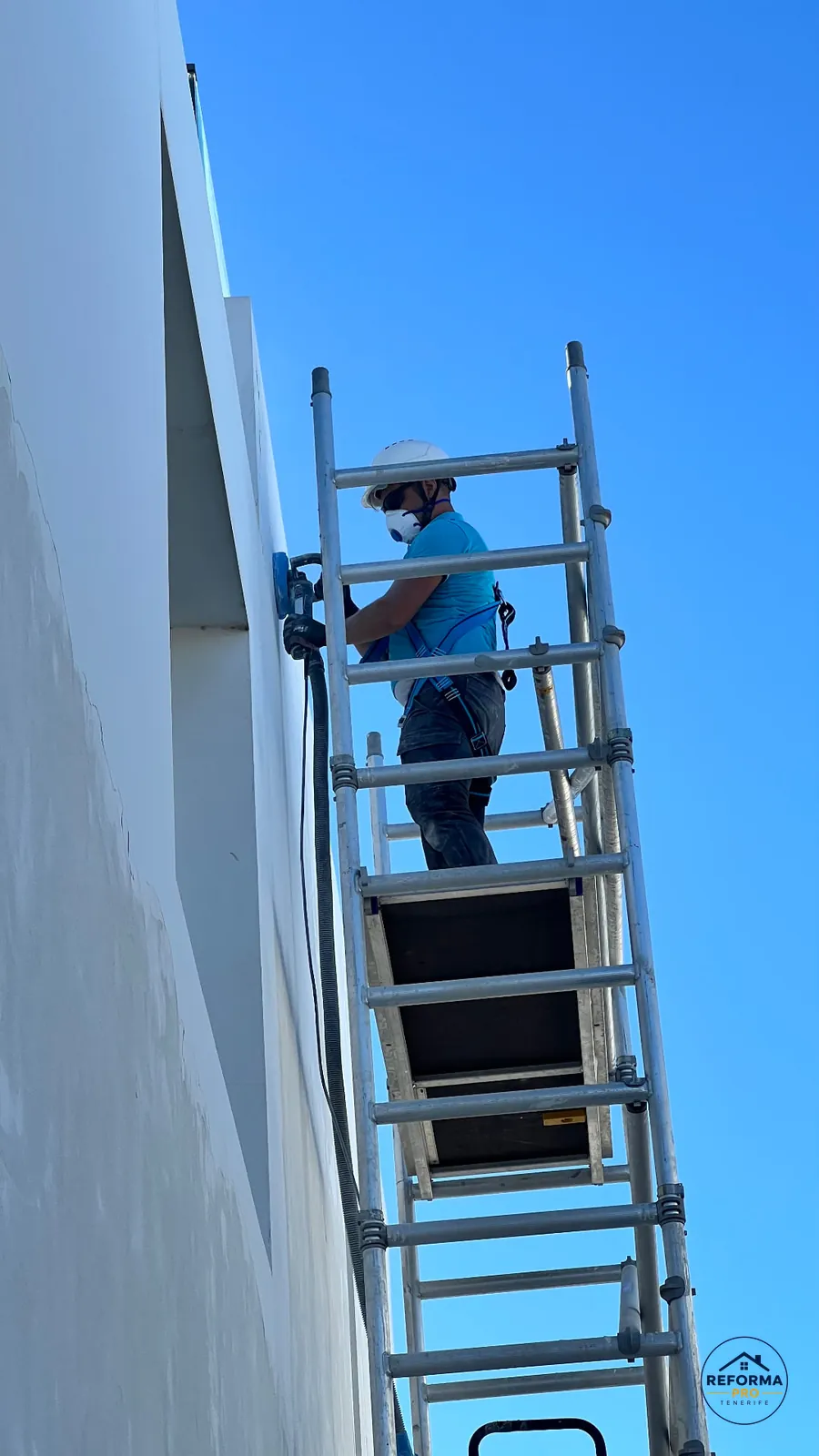
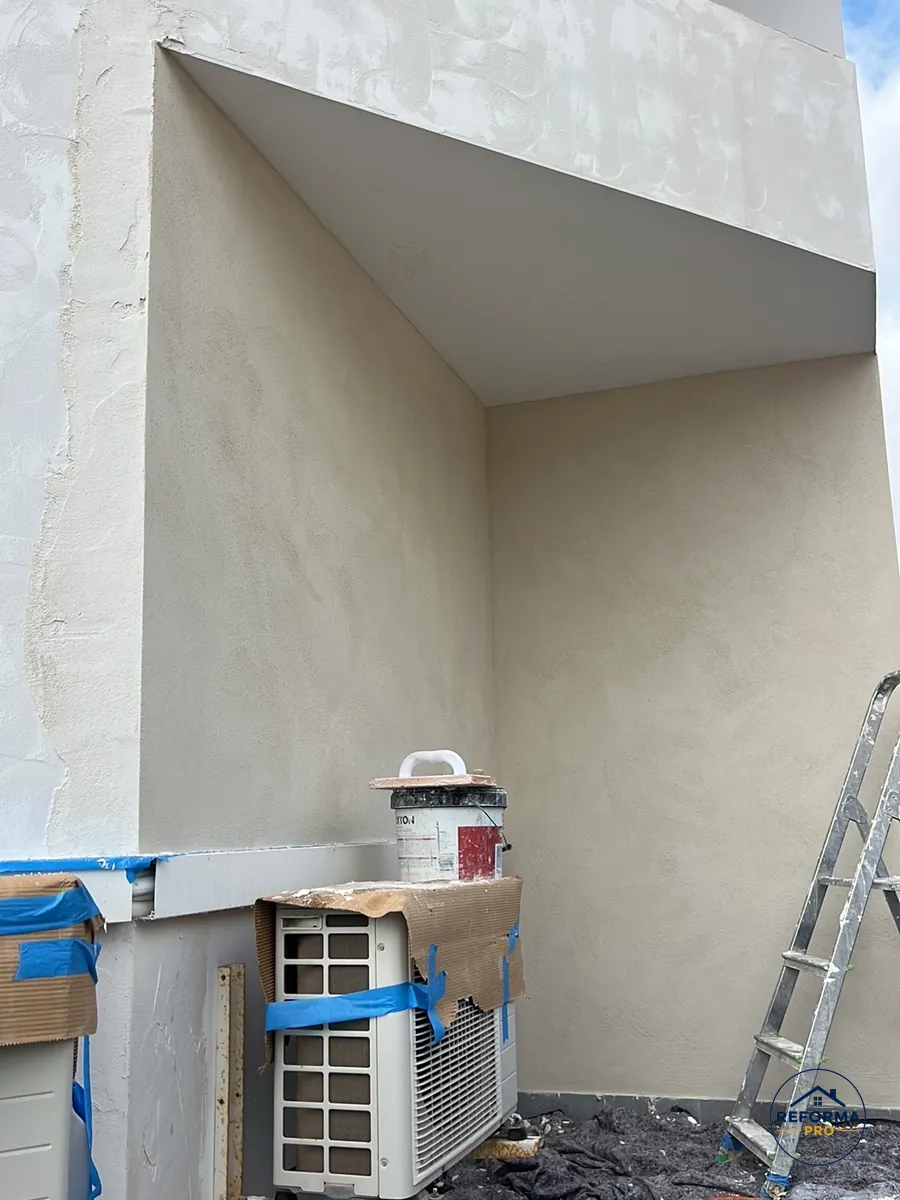
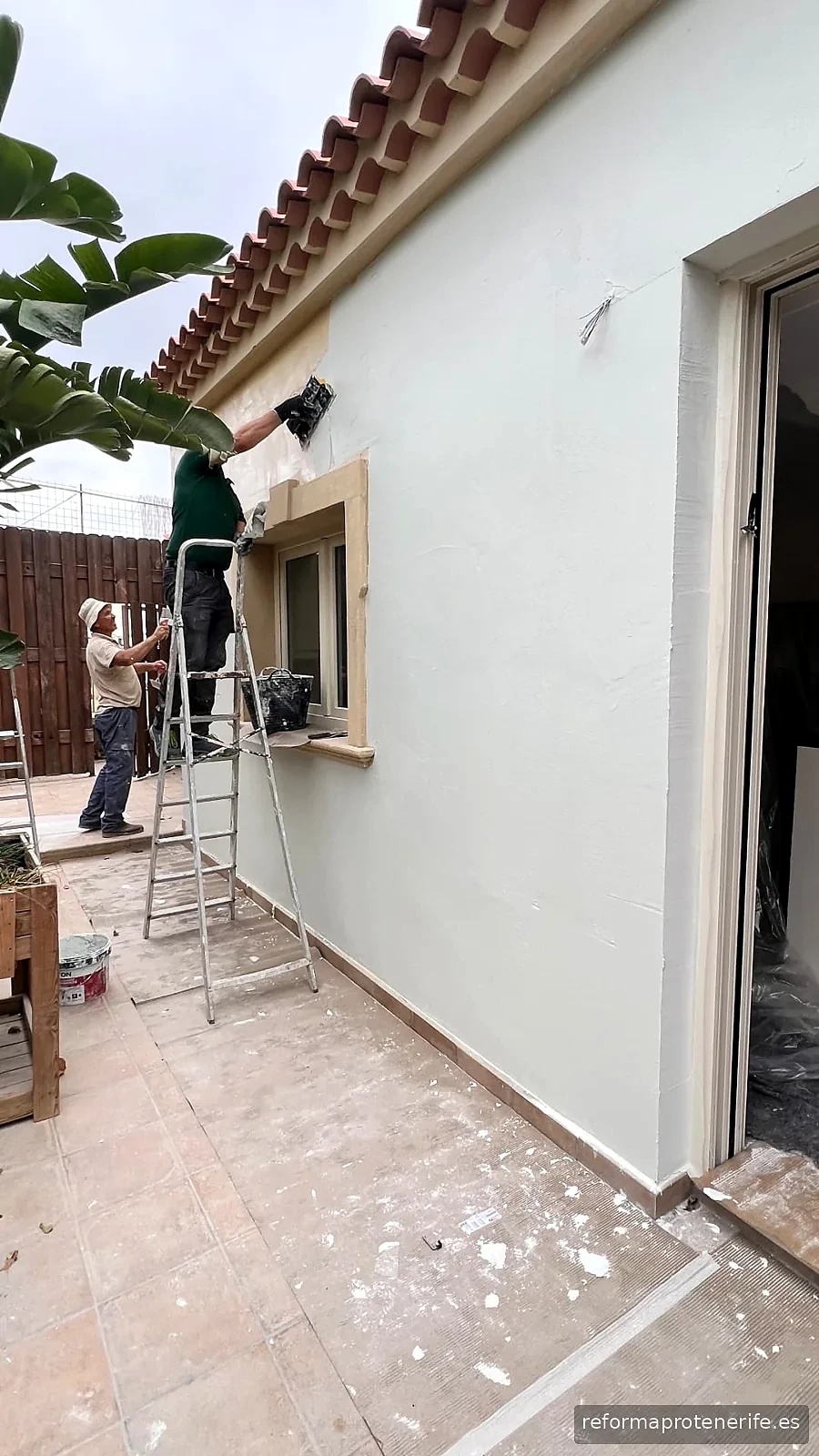
- Repair of cracks, fissures and loose plaster
- Treatment for damp and salt air damage
- Waterproofing of walls and cornices
- Exterior painting with products designed for coastal climates
- Refurbishment of railings, mouldings and window sills
Apartment buildings
In residential buildings, work is usually approved at a community meeting. We can prepare a detailed quote to present to the community of owners and coordinate access and schedules with the property administrator.
Permits
Painting or repairing a facade usually requires a comunicación previa submitted to the Ayuntamiento, and if scaffolding is needed on a public pavement or road, a public space occupancy permit as well. We verify this with you before starting.
Facade renovation in Tenerife: diagnose before applying finishes
A facade is assessed as a whole: wall areas, corners, copings, balconies and window junctions. A stain low down does not prove water is entering there. Tracing its path avoids repairing only the symptom while leaving the source unresolved.
The inspection distinguishes dirt, paint loss, cracks and render with doubtful adhesion. Previous repairs and changes in the damage also matter. Photographs taken on different dates help explain its development, but do not replace checking the substrate.
If fragments could fall, the priority is to protect the area and arrange a safe inspection. Do not strike a facade from a window to test it. Deformation, visible corrosion or damage potentially affecting load-bearing elements requires a specific technical assessment.
How cracks and detached facade finishes are repaired
A stable surface crack may be suitable for localised treatment compatible with the finish. A crack that is still moving requires investigation of its cause before a repair is chosen. Its visible width alone determines neither its seriousness nor the solution.
Detached areas are removed back to sound material using an appropriate method and access equipment. The thickness is then rebuilt with compatible products. Covering hollow render with a new layer adds weight but does not restore its lost bond.
At junctions between different materials, movement may need accommodating or the finish may need local reinforcement according to the system. Mesh does not replace a necessary joint or turn a surface repair into structural strengthening. Building work is specified where the scope goes beyond simple repainting.
Where deterioration is water-related, entry points are checked first. Waterproofing must be coordinated with repairs to avoid covering substrates that are still damp or leaving copings and junctions unresolved.
Monocouche render facades: preserving texture and compatibility
Monocouche is a mortar-based render whose performance depends on the substrate, application and exposure. Before work begins, its cohesion, adhesion, absorption and previous repairs are assessed. Not every paint or repair mortar can be assumed compatible.
Patches often differ from the original wall area in texture, absorption or colour ageing. This limitation should be discussed beforehand, especially on prominent elevations. Sometimes repairs within defined boundaries and a more extensive finish help reduce contrast, always after removing unsound material.
Cleaning must suit the finish's strength. Excessive pressure can erode the surface or encourage water to enter through cracks. An inconspicuous area is tested first and the method chosen according to the result, rather than treating the whole building as a uniform surface.
Existing joints are retained and their edges checked. Filling them rigidly to hide them can transfer movement into the render. The aim is to restore continuity and protection where appropriate without erasing details that allow the external wall to function.
Exterior paint, salt deposits and differences between north and south
Near the sea, surface salt deposits are distinguished from salts associated with moisture moving through the substrate. Their presence requires investigation of the source and preparation of the base. Painting over efflorescence without addressing the cause can lead to renewed detachment.
Paint is selected for compatibility, exposure and its behaviour towards water and water vapour. The least permeable finish is not automatically best: it may be unsuitable if it prevents existing moisture from escaping. Preparation and waiting times are part of the system, not optional steps.
In humid northern areas such as Puerto de la Cruz, drying and weather forecasts are checked. On sunny southern facades, for example in Arona, substrate temperature and wind can affect application. These are general guidelines: each elevation has its own exposure.
Painting in Tenerife is coordinated once the substrate is stable. Exterior paint is not a substitute for repairing open joints, faulty drip details or water ingress at vulnerable details.
Scaffolding, platforms and other access equipment: what affects the work?
Access equipment is chosen according to height, geometry, available support and the scope of work. A narrow courtyard offers different possibilities from a facade facing an open plot. The choice and safety arrangements must allow work to proceed while protecting people passing below.
Entrances, widths, obstacles and the possibility of installing protection are checked. It is not assumed that a platform can reach every point or that scaffolding can stand on any surface. Working from windows is not proposed as an improvised alternative either.
On older streets in La Laguna or Santa Cruz, access restrictions and unloading can be major factors. If public space must be occupied or particular site conditions apply, administrative requirements are checked before a start date is set. The permits and licences guide helps prepare that enquiry.
How to prepare facade work for a community of owners
A community of owners needs an understandable description of the damage and areas to be treated. It helps to separate essential safety and maintenance work from aesthetic decisions. This allows quotations with the same scope to be compared, rather than offers omitting different repairs.
Before work begins, a contact person, working hours, notices and protection for windows, terraces and access routes are agreed. Residents need to know when to remove objects or keep particular openings closed. Scope changes are documented so the property manager and community can assess them.
In buildings with holiday rentals, access and communication are coordinated in advance. It is not always possible to avoid all disruption to occupants. Alternatives for affected routes should be planned, and periods dependent on weather or drying explained.
Facade repair stages and indicative timescales in Tenerife
An accessible localised repair may take two to five working days, plus the necessary waiting periods. A complete facade can take several weeks depending on area, access equipment and deterioration. A reliable duration cannot be given without a visit and a distinction between working time and drying time.
Rain, wind or a substrate temperature outside the product's specified conditions may require a different sequence. In buildings from the 1970s and 1980s, removing unsound material can also reveal damage greater than initially visible. Any extension of the scope is explained before that part continues.
- Inspection, scope definition and technical assessment where appropriate.
- Preparation of access, protection and coordination with occupants.
- Removal of unsound material and checking the exposed substrate.
- Repair of identified damage and water entry points.
- Drying, preparation and application of a compatible finish.
- Checking finishing details, cleaning and organised removal of access equipment.
Facade renovation prices: assessment after a visit
There is no official rate per square metre for facades or monocouche render. A price is provided after the free visit; any estimate is indicative, excluding IGIC, and the final price depends on the confirmed scope. Interior painting rates are not applied to exterior repairs.
Height, accessibility, the actual damaged area, finish type and the need to repair particular details all affect cost. The quotation should distinguish removal of unsound material, rebuilding, finishing and access equipment, and clarify materials and waste removal. Two facades of equal area may need very different work.
Reforma Pro Tenerife is based in Puertito de Güímar (38508) and serves other areas of the island. To organise the decorative stage without confusing it with substrate restoration, see walls and finishes. The priority is to repair what is necessary before deciding how it will look.
Frequently asked questions
How often should a facade near the sea be painted?
It depends on sun exposure, the paint used and the amount of salt air. It is best to check it as soon as peeling or staining appears, before water gets in.
How much does it cost to renovate a facade?
There is no fixed price: it depends on square metres, height, access equipment and the condition of the render. A quote is prepared after the free site visit.
Does a fine crack mean the facade only needs painting?
Not necessarily: its position, development and relationship with other damage need checking. Paint may disguise it without resolving the cause. If it remains active, treatment must follow the diagnosis.
Can monocouche render be repaired without a visible patch?
An exact colour and texture match is not always possible. Ageing of the original wall area has a major influence. A reasonable result is agreed, with a more extensive finish where appropriate to reduce contrast.
Are white stains always salt from the sea?
No, they may also be salts carried by moisture from the substrate itself. Appearance alone does not identify the source. Water paths and exposure conditions need checking before treating the surface.
Does all the old render need removing?
That depends on how much material remains bonded and on compatibility with the repair. Some facades allow localised removal; others need more extensive work. The decision is based on checks, not just what looks loose to the naked eye.
Can a facade be painted immediately after washing?
The substrate must first meet the selected system's moisture requirements. Orientation and weather affect drying. Applying paint too soon can compromise adhesion and the result.
What should I do if a fragment falls into the street?
Avoid walking or standing below the area and inform whoever manages the building so safe measures can be arranged. If there is immediate danger, contact the appropriate services. Do not try to remove other fragments from a window or improvised ladder.
Work photos