

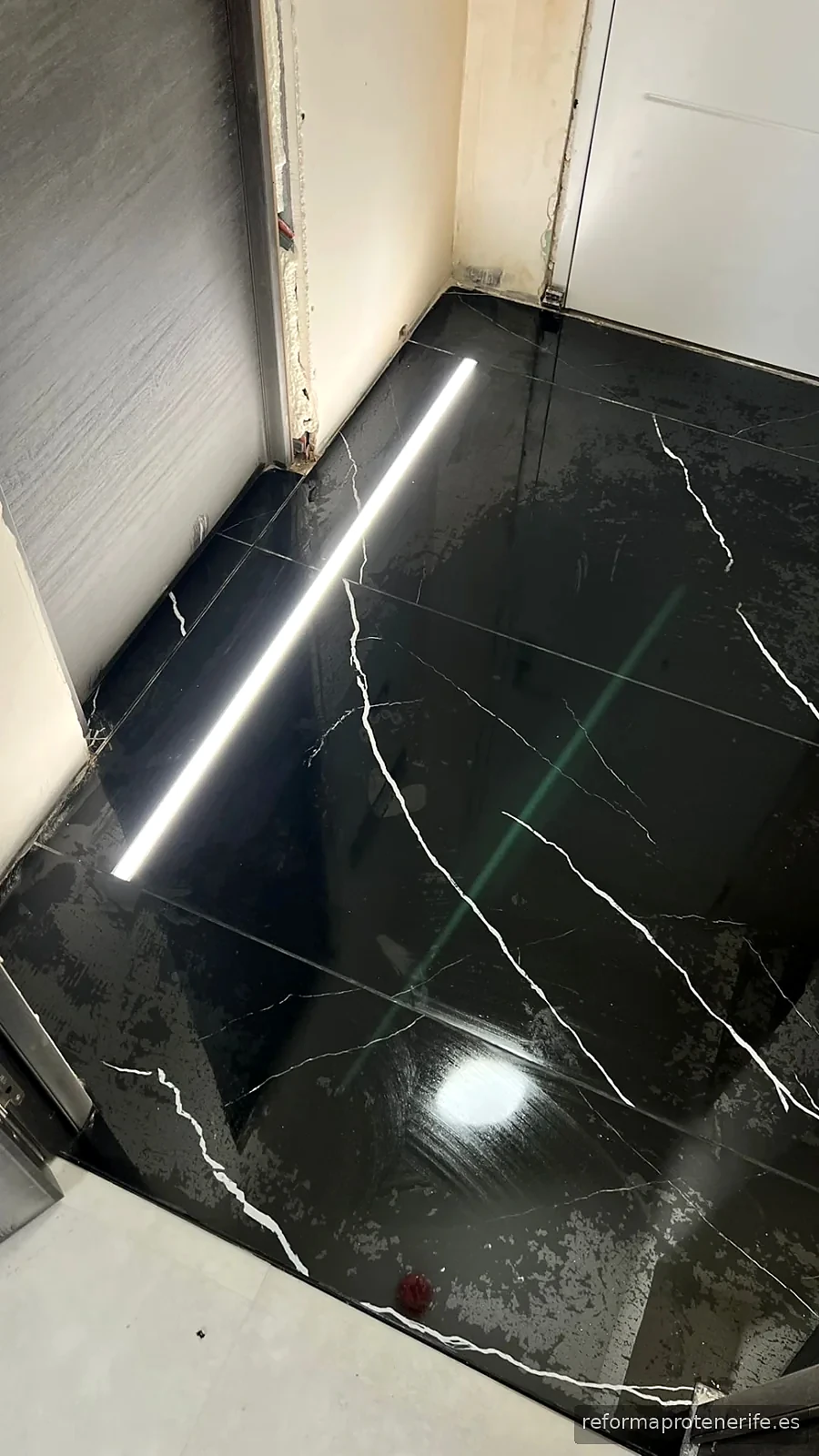
PVC or marble
We help you choose the material based on intended use and budget.
- PVC panels: lightweight, fast to install, and water-resistant
- Marble or porcelain slabs: high-end finish
- Showers, full bathroom walls, and kitchen splashbacks
- Living rooms with decorative panels and integrated lighting
Over existing tiles
If the existing tiles are firm and secure, the panel is glued directly over them: less rubble and fewer days of work. If there is damp, we resolve it first.
PVC panels and marble: check which material you are choosing
A veined sample does not identify the material: a marble-effect PVC panel is not a natural marble slab. Before deciding, check the composition, thickness, dimensions and permitted uses. These details determine preparation, handling, adhesive and maintenance, even when two finishes look alike in a photograph.
PVC panels up to 2.60 m long allow tall wall areas to be planned with few joints. That dimension does not mean every wall can be covered from floor to ceiling: the finished height, top junction and clearances specified for the system must be measured. Width and availability are confirmed for each model.
Marble has natural variations and requires assessment of its weight, support and fixing. It cannot be treated as a lightweight sheet or cleaned with the same products as PVC. This guide covers choosing and fitting over a retained wall finish; for an overview, see our bathroom renovation services.
When can panels be fitted over existing tiles?
Keeping existing tiles makes sense if the finish and its supporting layers are sound, free from active damp and sufficiently flat for the system. The inspection must cover the whole wall, not just an accessible corner. A shiny, apparently clean surface can conceal grease, old sealants or poorly bonded tiles.
Checks cover bulges, cracks, open joints and areas that sound different when tapped. These checks provide clues, not an automatic guarantee of strength. If there is doubt, local tests may be needed before installation is approved, especially where the new finish adds significant weight.
This is not a suitable way to hide leaks, crumbling substrates or movement that still needs investigating. Nor should tiles be retained at any cost if the combined thickness interferes with taps, frames or the shower screen. In those cases, local repairs are compared with removing the entire finish.
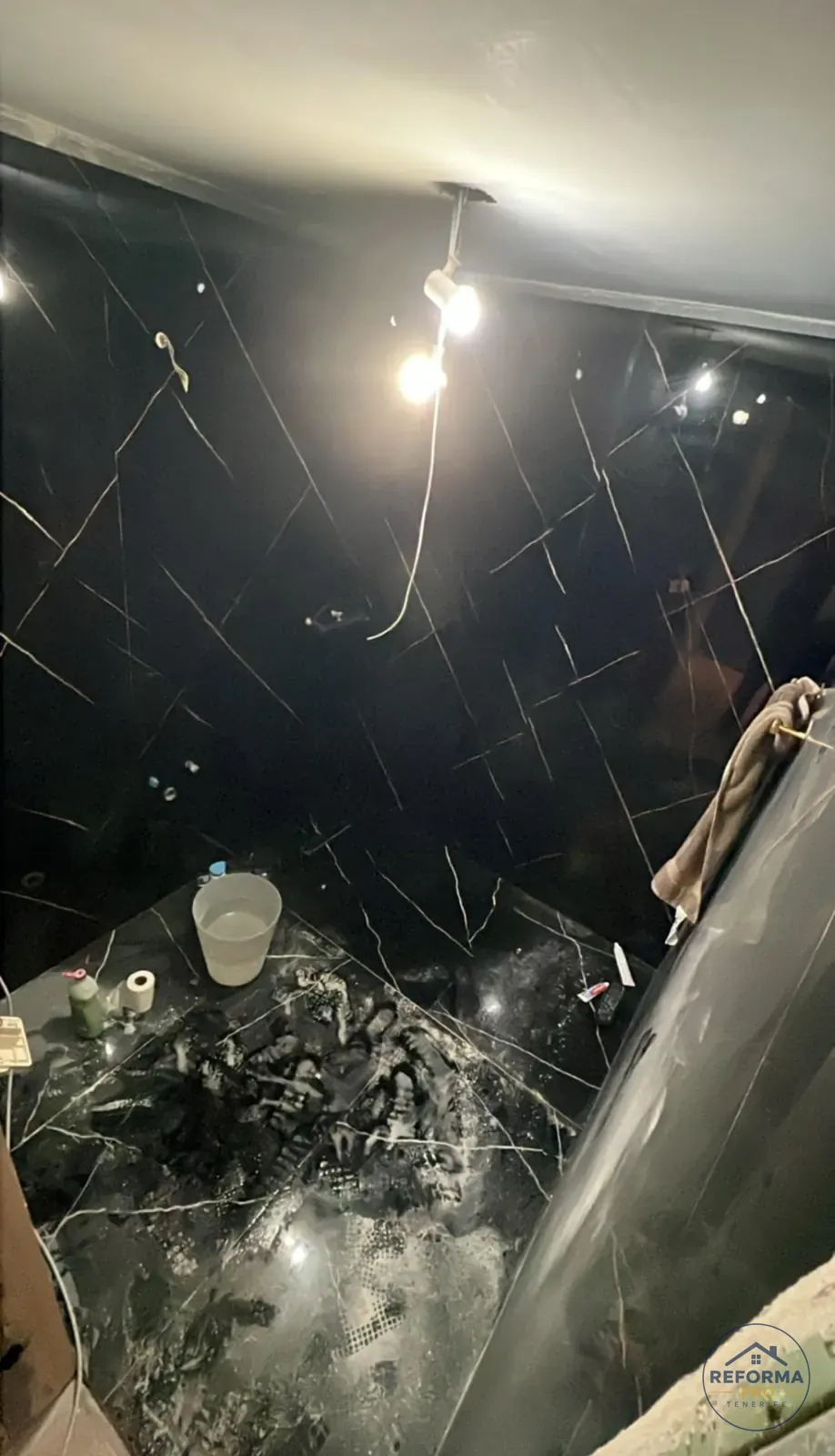
How to prepare tiles before fitting panels
First, remove accessories and sealants that would interfere with adhesion. Clean with compatible products and remove cleaning residue, then check that the substrate meets the required moisture conditions. Bonding onto a film of soap or degreaser can compromise the result.
Loose tiles are made good and gaps levelled with compatible materials. Depending on the chosen system, mechanical preparation or a specific primer may be required. Not all panels allow the same procedure, and sanding out of habit is no substitute for checking the installation instructions.
Preparation must leave a base flat enough to prevent distortion, gaps in support or forced junctions. Adhesive must not be used as an improvised filler beyond its working thickness range. Previous repairs must reach the specified drying or curing stage before receiving the new finish.
Compatibility checks
The adhesive must suit both the substrate and the back of the panel. Some products can attack certain plastics or stain natural stone, so the specific system is checked and tested where appropriate. Pack size or a general-purpose label is not enough to choose by.
2.60 m panels: planning joints, cuts and finishing details
Each wall is measured at several points and checked for square. Before cutting, decisions are made on joint positions, vein alignment and which piece will finish beside the door. Planning the layout avoids a narrow strip or a joint awkwardly aligned with the taps.
Fewer joints does not mean no joints. Panel connections, corners, perimeters and changes of material are finished using the specified system: trims, sealants or other compatible solutions. The required movement clearances must be respected; forcing a panel between floor and ceiling can affect its performance.
The effect of the extra thickness on sockets, cover plates and shower screen brackets is also calculated. Access panels and valves needing maintenance must remain accessible. Before ordering a large piece, check that it can pass through the building entrance, stairs and doorway without bending it or damaging its edges.
What makes a panel suitable for use inside a shower?
A water-resistant material does not prove that the entire wall is watertight. Confirm that the model is suitable for that exposure and that its joints, cuts and junctions form an appropriate system. The bottom edge beside the tray and tap penetrations need particular attention.
The continuity of water protection and compatibility with existing or new waterproofing are assessed. A surface bead of sealant is not a substitute for every underlying construction detail. If there are leaks, their source is identified first through the appropriate waterproofing checks.
Accessories need anchoring into the load-bearing substrate rather than relying on the panel alone. Every penetration must be detailed to prevent water entry. Grab rails, furniture and shower screens impose different loads and may require reinforcement or a fixing strategy agreed before cladding.
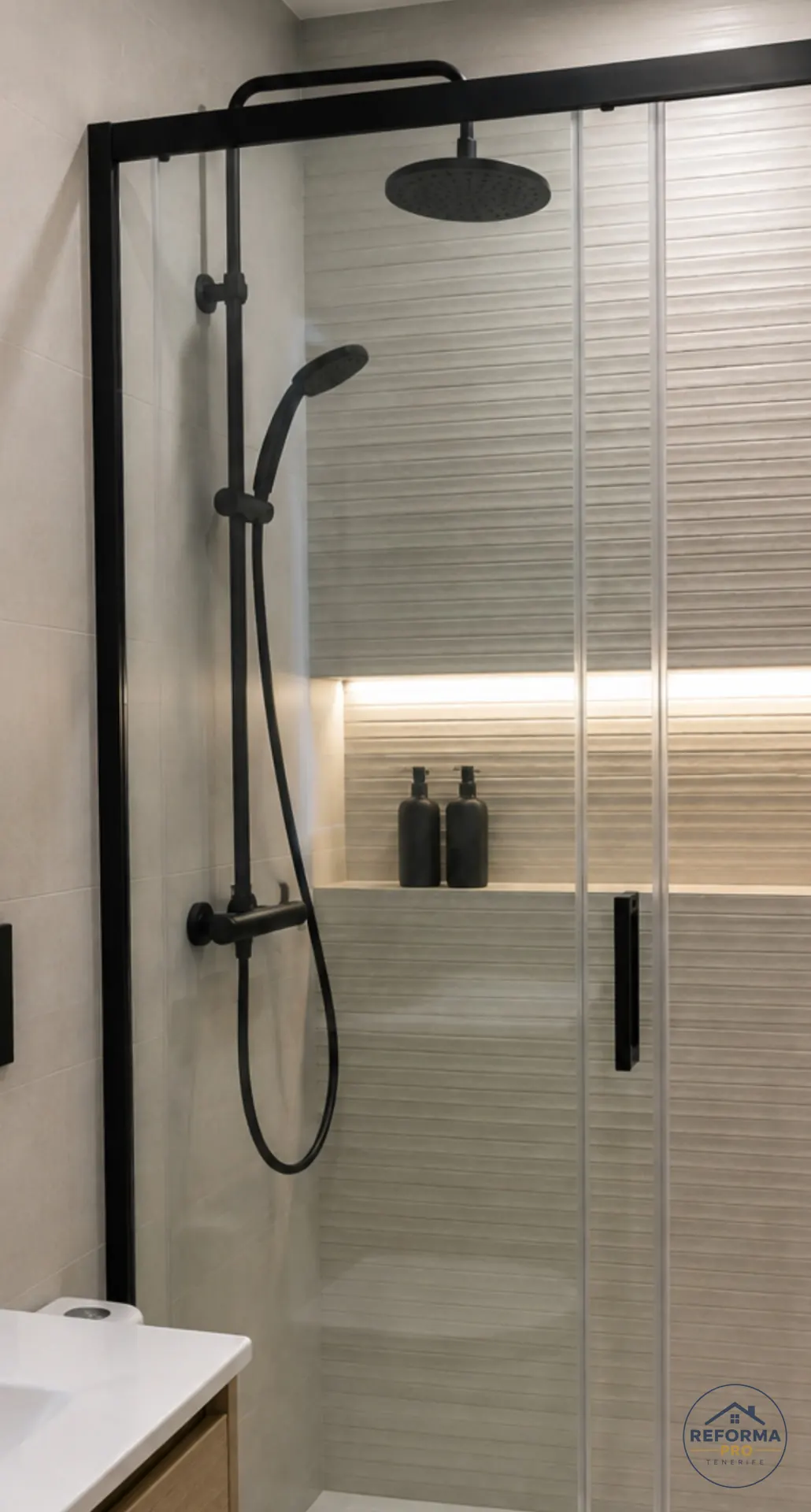
Panels or tiles: differences in installation and maintenance
There is no universal winner: geometry, use, access and ease of sourcing replacements all matter. A bathroom with many corners, niches and access panels may take longer to fit than expected. A large, simple wall makes better use of large formats and allows orderly joint placement.
Tiling work offers other texture and layout options; panels can reduce visible joints and avoid some demolition where the base allows. Neither option removes the need to maintain seals or permits unresolved damp to be ignored.
- Visible joints
- Panels: Fewer joints depending on size and layout.
- Tiles: More joints; the number depends on tile size.
- Fitting around obstacles
- Panels: Large cuts that require planning.
- Tiles: Flexible layout, with more pieces and finishing details.
- Local repairs
- Panels: May require replacement of a whole panel.
- Tiles: Individual tiles may be replaceable if spares and a suitable substrate are available.
- Existing base
- Panels: Needs stability and compatible preparation.
- Tiles: Also requires checks on adhesion and the substrate.
How panel installation is organised and how long it takes
A limited area of cladding on a prepared base may take two to five days, including certain waiting periods, depending on the area and system. If repairs, waterproofing or waiting for parts are involved, the overall work may exceed a week. These are planning ranges, not a promise of availability or immediate use.
Do not schedule the first shower just because the panels are in place: adhesives and sealants have their own setting times. Holiday accommodation should allow a buffer before the next guests arrive. Handover must distinguish visually finished work from a surface ready for water exposure.
- Site visit, material identification and checks on the substrate, measurements and access route.
- Layout, supply confirmation and specification of trims, junctions and maintenance access.
- Necessary removal work, cleaning, repairs and compatible preparation of the base.
- Dry fitting, cutting, fixing according to the system and detailing joints and penetrations.
- Finishing checks and instructions on when the surface can be cleaned, used and exposed to water.
How much does wall panelling cost in Tenerife?
We do not publish an official rate for these panels: pricing is provided after the free site visit. Any earlier estimate is indicative and excludes IGIC; the final price is set out in writing after checking the substrate and scope. Materials and supply are itemised rather than assumed to be included.
The actual material, available sizes, cuts, preparation and handling affect the quote. For marble, weight and access arrangements need specific assessment. In Tenerife's old town centres and shared residential buildings, stairs, parking and working hours can shape logistics as much as the surface area.
Our base is in Puertito de Güímar, 38508. We serve other parts of the island without presenting them as offices: in the humid north, we pay particular attention to drying conditions; in the sunny south, to exposure and temperature during installation. Near the sea, trims and fittings should be maintained according to their instructions.
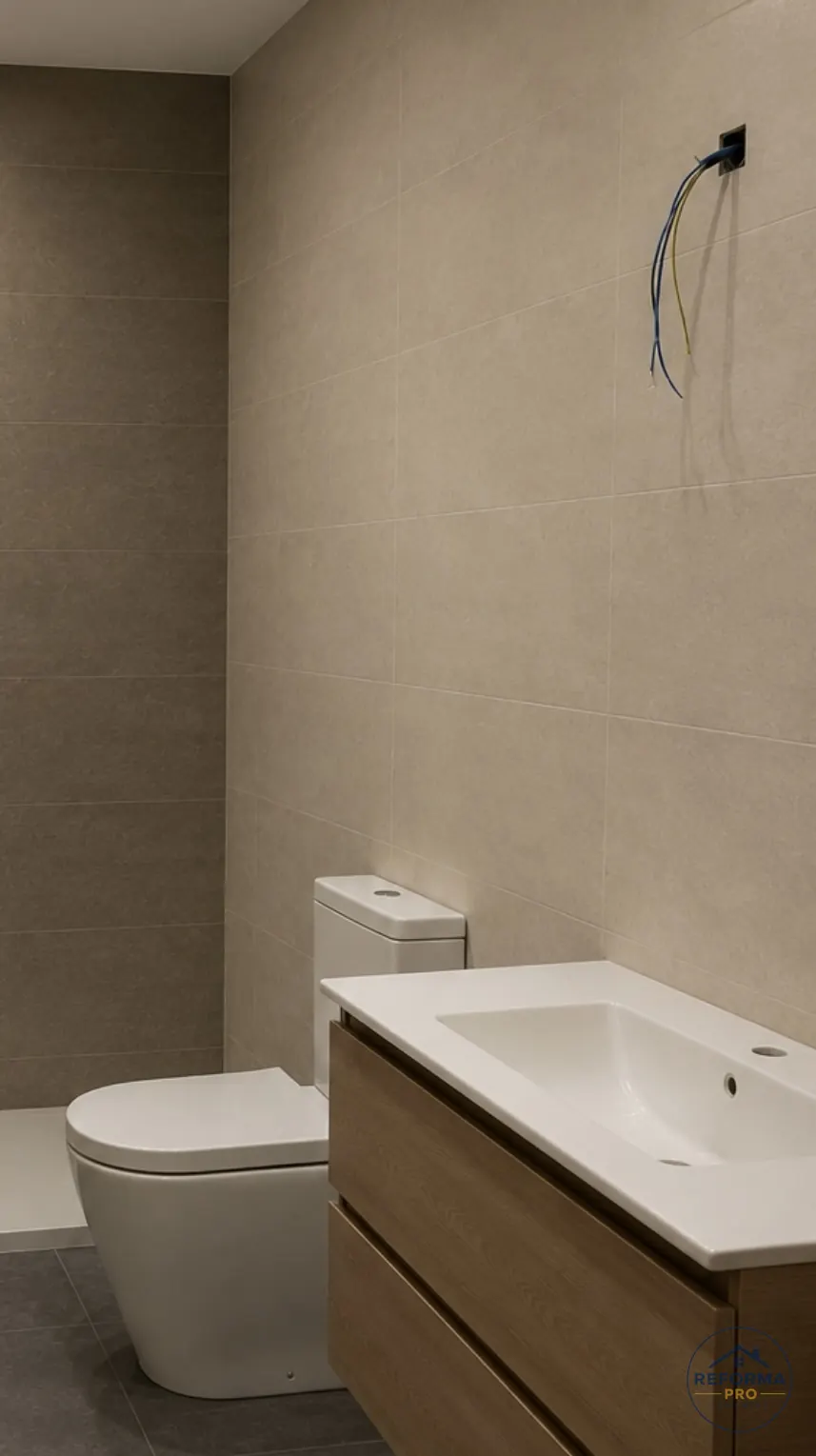
The bathroom and stoneware images in this guide show related settings and junction details, not specific PVC or marble panel models. If the initial problem is a persistent stain, consult the condensation or water ingress guide first.
Frequently asked questions
How much do PVC bathroom panels cost?
It depends on the model and the square metres. We don't publish a fixed rate: send us photos on WhatsApp, and we'll provide a quote after the site visit.
Is a marble-effect panel made of natural marble?
Not necessarily: the pattern may be printed on PVC or another material. Ask for the composition to be identified, as it determines weight, bonding, cleaning and suitability for the intended use.
Does a height of 2.60 m eliminate all joints?
It can only reduce horizontal joints if the measurements and system allow. Side junctions, corners and perimeters still need to be detailed correctly.
Can shut-off valves be covered?
Anything that needs operating or maintaining must not be left inaccessible. The layout must allow suitable access before the panel is cut and fitted.
How do you clean bathroom marble?
Use products compatible with the stone and follow the finish instructions. Household acids and some limescale removers can leave marks, so they should not be used simply because they are suitable for ceramic tiles.
What happens if a panel is damaged?
Repairs depend on the material, fixing method and joint positions. An entire piece may need replacing, so retain the product details and check replacement availability.
Can existing accessories be refitted over the panels?
Their fixings and effective anchoring length are checked with the added thickness. The panel must not be assumed to support loads that need fixing into the wall.
Can the panels also be used on floors?
A model designed for walls must not automatically be used as flooring. Check that the specific product is designed to be walked on and meets the conditions of its intended use.